
Google’s September AI Max transition puts a useful deadline in front of marketers. Eligible Search campaigns using automatically created assets and campaign-level broad match are beginning to move into AI Max this month. Google delayed the Dynamic Search Ads transition until February 2027, but the September upgrades still push more campaign work into AI-assisted matching and creative execution.
For agencies, freelancers, and small businesses, the main operational question is not whether AI can create another headline or find another query. The harder question is how much human review each automated action deserves.
That is where an approval budget helps.
Set the Approval Budget
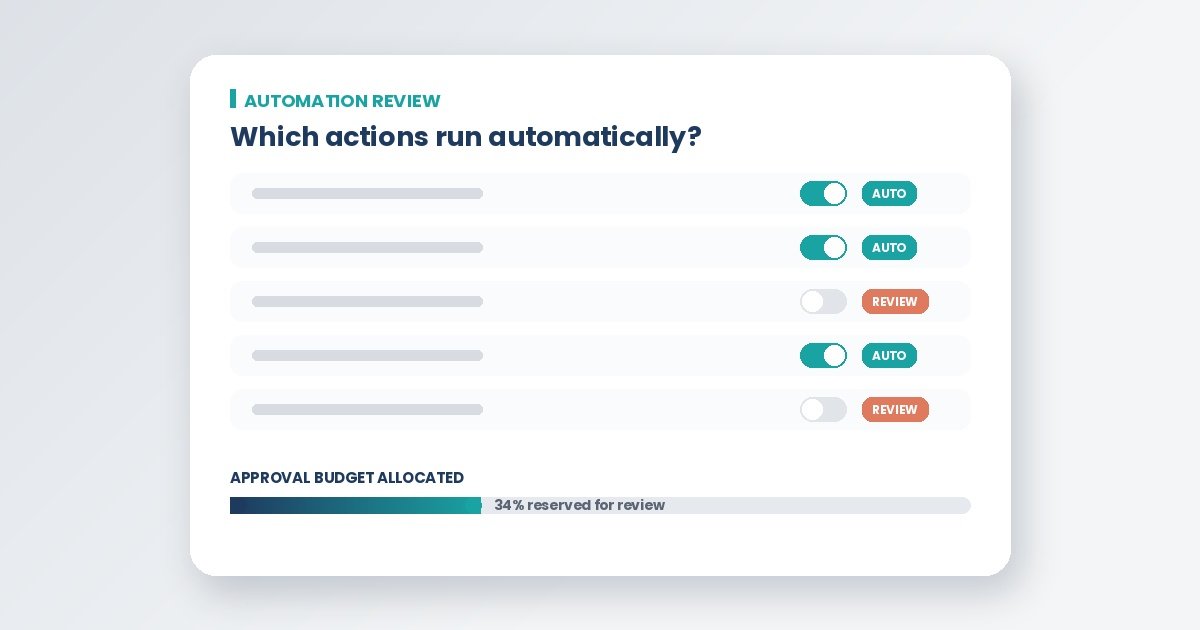
An approval budget is the amount of human attention a team deliberately reserves for reviewing AI-driven work before it reaches customers or changes a campaign. It is not a financial budget. It is a way to allocate scarce judgment.
Marketing teams already do this informally. A junior employee may draft ten social posts while a manager reviews all ten. A trusted specialist may update a landing page without approval but ask for review before changing a pricing claim. AI increases the volume and speed of possible actions, so informal review rules break down quickly.
Match Review to Consequence
The first step is to separate reversible actions from consequential ones.
A low-risk content variation that can be removed in minutes may need only sampling. A new claim about a product, a change to a regulated statement, a large budget shift, or a landing-page change affecting thousands of visitors deserves a stronger gate. The point is to match review intensity to the cost of being wrong.
Google’s own AI Max design reflects part of this logic. The platform includes controls around brands, locations, text, URLs, and experiments. Those controls matter because performance automation works better when marketers can steer the system rather than simply accept whatever it produces.
But controls alone do not solve the review problem. Teams still need to decide where human attention goes.
A useful operating rule is to classify AI-driven marketing actions before scaling them. Routine actions can run automatically within clear boundaries. Higher-consequence actions should wait for approval. Unusual cases should escalate instead of forcing the system to guess.
Webflow’s September 2 launch of Source offers a broader example. The platform is designed for marketers, designers, developers, and agents working in shared environments with role-based access, approval paths, and audit trails. That structure recognizes a basic reality of agentic work: speed becomes useful when authority is explicit.
The same principle applies to a small agency using AI for search, email, content, or social media. The agency does not need enterprise governance software to start. It needs a short list of actions the AI may take alone, actions that require review, and actions it may never take without a specific person’s approval.
Track the Review Load
Then track the review load.
If a marketer has to inspect every AI-generated variation, the automation may create more throughput without creating more useful capacity. Measure how many items require review, how many reviews lead to correction, how long corrections take, and which mistakes recur. Those numbers show where the system deserves more autonomy and where it still needs tighter limits.
Teams should also keep a record of consequential changes. When an AI-assisted campaign performs badly, managers need to know what changed, when it changed, and whether a person approved it. A simple change log can prevent the familiar postmortem problem where everyone sees the result but nobody can reconstruct the decision.
Protect Accountability
This matters for client relationships as much as campaign performance. Agencies sell judgment. Clients may welcome faster production, but they still expect someone to know why a campaign changed and who was responsible for the decision. An approval budget protects that accountability while letting AI handle more routine work.
The goal is not to slow automation. The goal is to spend human attention where it has the highest value.
As AI Max and other agentic marketing tools take on more execution, teams should resist measuring success by the number of tasks automated. A better measure is how much reliable work reaches the market without increasing correction costs, brand risk, or manager review time.
Automation scales when judgment scales with it. An approval budget gives marketers a practical way to make that happen.
About the Author
Gleb Tsipursky, PhD, is a behavioral scientist, CEO of Disaster
Avoidance Experts, and author of The Psychology of AI Adoption at
Work: From Resistance to Results (Georgetown University Press, 2026).

