
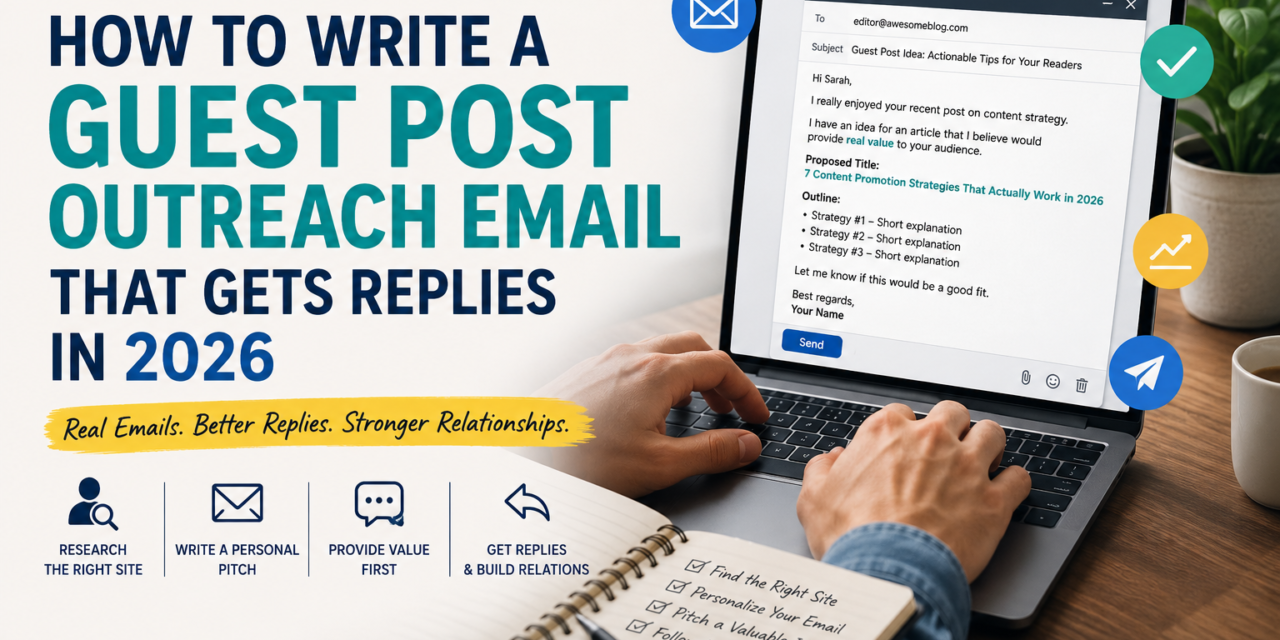
You find a website that looks perfect for a guest post. Its audience matches yours, the content is active, and the articles are genuinely useful. You spend time browsing the site, write an email, click send, and then wait.
Nothing happens.
A week later, you notice a new guest article on that same website. The opportunity was real. The problem was probably not your topic. More often, it is the outreach email: too generic, too long, too focused on getting a link, or too vague for an editor to evaluate quickly.
A good guest post outreach email is not a trick for forcing a reply. It is a short editorial pitch that shows you understand the publisher, have a useful idea for its readers, and can make the editor’s job easier.
Why Most Guest Post Outreach Emails Get Ignored
Editors receive more pitches than they can reasonably review, so they scan messages for relevance and effort. Generic introductions such as “I found your amazing blog” or “I would like a backlink” immediately make the email look like mass outreach rather than an editorial proposal.
The other major problem is vagueness. Saying you can write about “SEO,” “business,” or “digital marketing” gives the editor another task: figuring out what you actually want to publish. A better guest post pitch gives them a proposed headline, a clear angle, and a quick explanation of why it belongs on their site.
Long emails can also hurt. Your first message should make it easy to understand the idea without requiring the editor to read your background story, service list, or a long explanation of your business.
What Makes a Good Guest Post Outreach Email?
A strong guest post outreach email has three jobs: prove that you researched the publisher, offer a useful article idea for the publisher’s audience, and make it easy for the editor to reply.
The best emails usually open with one real observation. Instead of writing, “I enjoy your blog,” mention a recent post and a detail that stood out: “Your article on local SEO reporting was helpful, especially the section on separating branded and non-branded visibility.”
Then pitch a specific article, not a broad category. “How Local Businesses Can Audit Citation Errors Before They Affect Visibility” is easier to assess than “I can write about local SEO.”
Finally, include a relevant credential or published sample. Editors do not need a full resume. They need a quick reason to trust that you can deliver a polished, useful draft.
How to Write a Guest Post Outreach Email Step by Step
1. Research the website
Read several recent posts before writing your email. Look for recurring topics, writing style, article format, audience level, and whether the site accepts outside contributions. A strong publisher outreach process starts with understanding the publication before you send your pitch.
Focus on relevance before authority metrics. A well-maintained niche publication with the right readers can be more valuable than a broader site where your topic feels out of place. If you are new to the process, our guest posting guide can help you understand the fundamentals before starting your outreach.
2. Find the right contact
Try to identify the editor, content manager, founder, or contributor manager rather than relying on a general inbox. Check author pages, editorial pages, LinkedIn profiles, or a contact page.
Use their real first name if you can confirm it. “Hi Sarah” is better than “Dear Sir/Madam,” but never guess. If the right contact is unclear, “Hi Editorial Team” is safer than using the wrong name. A focused blogger outreach process can also help you identify relevant contacts and publication opportunities.
3. Write a relevant subject line
Your guest post email subject line should tell the editor what the email is about without sounding promotional. Keep it clear, specific, and editorial.
4. Personalize the opening
A personalized guest post outreach email does not need a long paragraph about the website. One sentence is usually enough. Mention a recent article, recurring content category, or genuine content gap.
5. Explain why you’re contacting them
Keep this short. You do not need to explain your life story. One sentence about your relevant expertise and the fit for their readers is enough.
6. Suggest a useful topic
Give the editor a publishable idea. A clear headline plus a short outline works well.
Proposed headline: How to Audit a Backlink Profile Before Starting a Link Building Campaign
The article would cover:
- How to identify clearly irrelevant or suspicious backlinks
- Which backlink metrics deserve context instead of blind trust
- A simple monthly review process for small marketing teams
7. Explain the value for their audience
Briefly explain why readers would benefit. Keep the focus on the publisher’s readers, not your desired anchor text, rankings, or commercial page.
8. Briefly establish credibility
Share one relevant credential, published sample, first-hand insight, or research source. Do not exaggerate credentials or promise results you cannot support.
9. End with a simple call to action
Use a low-pressure question: “Would this be a fit for your editorial calendar?” “Would either of these topics be useful?” or “Interested in seeing a full outline?”
Guest Post Email Subject Line Examples
Here are realistic guest post email subject line ideas:
- Guest post idea: [Topic] for [Site Name]
- 3 article ideas for [Site Name]
- Content idea for your [Category] section
- A practical checklist for ecommerce SEO teams
- Follow-up from our LinkedIn conversation
- [Mutual Contact] suggested I reach out
Avoid clickbait, all caps, excess punctuation, and language that makes the email sound like an advertisement. The goal is to look like a thoughtful contributor, not a cold sales pitch.
Guest Post Outreach Email Template
Use this guest post outreach email template as a structure, not as a copy-and-paste message.
Subject: Guest post idea: [Specific Topic] for [Site Name]
Hi [Editor Name],
I enjoyed your recent article on [specific post or topic], especially the point about [specific detail].
I’d like to contribute a guest post for [Site Name]:
[Proposed Headline]
The article would cover:
- [Practical point one]
- [Practical point two]
- [Practical point three]
I think it would help your readers [specific audience benefit].
Here are two relevant writing samples: [Link 1] and [Link 2].
Would this be a fit for your editorial calendar?
Best,
[Your Name]
[Website or LinkedIn profile]
Keep it concise. The more you make the editor work to understand the pitch, the less likely they are to respond.
Guest Post Pitch Email Example
Here is a realistic guest post pitch email example:
Subject: 3 article ideas for Marketing Growth Weekly
Hi Ayesha,
I enjoyed your recent article about content refreshes, especially the point that old posts should be reviewed for intent before they are updated.
I write about SEO outreach and content strategy for marketing teams. I have three article ideas that may fit your audience:
- How to Qualify Guest Post Opportunities Without Chasing Vanity Metrics a practical relevance-first checklist
- Guest Post Outreach Emails That Editors Actually Want to Read examples of weak versus useful pitches
- How to Build an Outreach Process That Does Not Burn Your Email Reputation targeting, personalization, and follow-up habits
Here are two relevant samples: [Link 1] and [Link 2].
Would any of these be useful for your editorial calendar?
Best,
[Your Name]
This email is short, specific, and easy to answer. It offers choices while still showing that the sender understands the publication.
How to Write a Guest Post Pitch That Publishers Actually Want
If you are learning how to write a guest post pitch, start with the publisher’s existing content rather than your own service pages.
Search the site for your topic. Look for content gaps, outdated articles, missing audience segments, or questions readers may still have after reading the existing posts.
Strong pitch ideas often come from a missing subtopic, a practical checklist that improves on a broad guide, first-hand lessons from campaign work, or a follow-up to a topic the publisher already covers well. You can also use find publishers for guest posting as part of the research process.
Do not pitch an article just because it contains a keyword you want to target. Pitch it because the publisher’s readers would genuinely benefit from it.
Personalized Guest Post Outreach: What Should You Personalize?
Personalization should be real, relevant, and easy to verify.
- The editor’s name, if confirmed
- A recent article, category, or newsletter topic
- A specific content gap
- The proposed headline and angle
- The writing samples you share
Avoid fake personalization such as “I’m a huge fan of your website,” vague compliments, or a reference to an unrelated old article. You do not need to write every email from scratch, but you should customize the parts that prove you understand the publication.
How to Follow Up on a Guest Post Pitch
No response does not always mean rejection. Editors are busy, inboxes are crowded, and your email may have arrived at the wrong time.
Send the first guest post follow up email around four to seven business days after your original pitch. If there is still no response, one final follow-up about a week later is reasonable. After that, stop.
Subject: Re: Guest post idea: [Original Topic]
Hi [Editor Name],
Just following up on my article idea: [Proposed Headline].
I think the piece could be especially useful for your readers because it includes [specific benefit, example, data point, or framework].
If the topic is not a fit, I’m happy to suggest a different angle.
Best,
[Your Name]
Keep it respectful and brief. A follow-up should make the editor’s decision easier, not add pressure.
Common Guest Post Outreach Mistakes to Avoid
- Sending generic mass emails
- Pitching irrelevant topics
- Using weak subject lines
- Writing very long emails
- Using fake personalization
- Leading with backlinks rather than reader value
- Using spammy promises about rankings or instant results
- Requesting anchor text, multiple links, or dofollow guarantees immediately
- Following up aggressively
- Ignoring contributor guidelines
Guest posting should support relevant publishing, audience exposure, and legitimate editorial relationships. Avoid manipulative link schemes and content created mainly to influence rankings.
A Simple Formula for Better Guest Post Outreach
Research → Personalize → Pitch → Show Value → Ask → Follow Up
Research the site and find the right contact. Personalize your opening with one specific reference. Pitch a clear headline with a brief outline. Show value for their audience, not yourself. Ask a simple yes-or-no question. Follow up once or twice, then move on.
Final Thoughts
The best guest post outreach email is not necessarily the cleverest one. It is the one that shows you did the work before asking for someone else’s attention.
Spend more time choosing relevant publishers and shaping useful topics. Spend less time sending large batches of generic emails. A thoughtful pitch to the right editor is more valuable than dozens of messages that look copied and pasted.
Your goal is not to “get a backlink.” It is to publish useful content on a site where your audience already spends time. When you approach guest posting that way, your emails improve automatically.
If you need help building a more structured process, guest post outreach services and publisher outreach services can support research, targeting, and editorial communication. You can also explore our outreach best practices and outreach resources for additional guidance.
FAQ
How long should a guest post outreach email be?
Aim for roughly 80 to 150 words when possible. Include one personalized line, a specific topic, a brief audience benefit, relevant samples, and a simple question.
How many topic ideas should I include in a guest post pitch?
Two or three ideas are usually enough. They give the editor options without overwhelming them. Each idea should be a specific headline, not a broad category.
What is the best guest post email subject line?
A direct, specific subject line usually works best, such as “Guest post idea: [Topic] for [Site Name]” or “3 article ideas for [Site Name].”
Should I write the full article before pitching?
Usually, no. Pitch the idea first unless the publisher’s contributor guidelines specifically request a completed draft. Editors may want to adjust the angle before you invest time writing.
How many follow-ups should I send?
One follow-up after four to seven business days and one final follow-up about a week later is generally enough. If there is no response after that, move on and preserve the relationship.


With havin so much written content do you ever run into any issues
of plagorism or copyright infringement?
My site has a lot of completely unique content I’ve either written myself or outsourced
but it appears a lot of it is popping it up all over the web without my agreement.
Do you know any techniques to help prevent content
from being ripped off? I’d certainly appreciate it.
Yes, that’s very common when publishing something online. You can’t prevent people from copying your work, but if you monitor it and take action when your original content is copied, you can avoid it to some extent. Thanks for bringing this up!
Keep on writing, great job!