Despite all the major changes in search, one question keeps coming up: Does SEO still work in 2026?
Yes, but the way we need to approach it has shifted rapidly.
In 2026, Google rankings depend on most sites matching and meeting the search intent by providing helpful content that proves E-E-A-T, which is Experience, Expertise, Authoritativeness, and Trustworthiness.
Google ranks websites purely based on relevancy, helpfulness, content quality, links, and technical accessibility, and last but not least, the overall satisfaction of the experience offered by a well-structured website. Google also announced that its generative search features rely on core SEO practices to provide the best results.
So, if you are wondering what matters most for SEO in 2026, the answer is that there is no secret ranking tip or trick. The SEO fundamentals still matter, but they need to be applied with more focus on users.
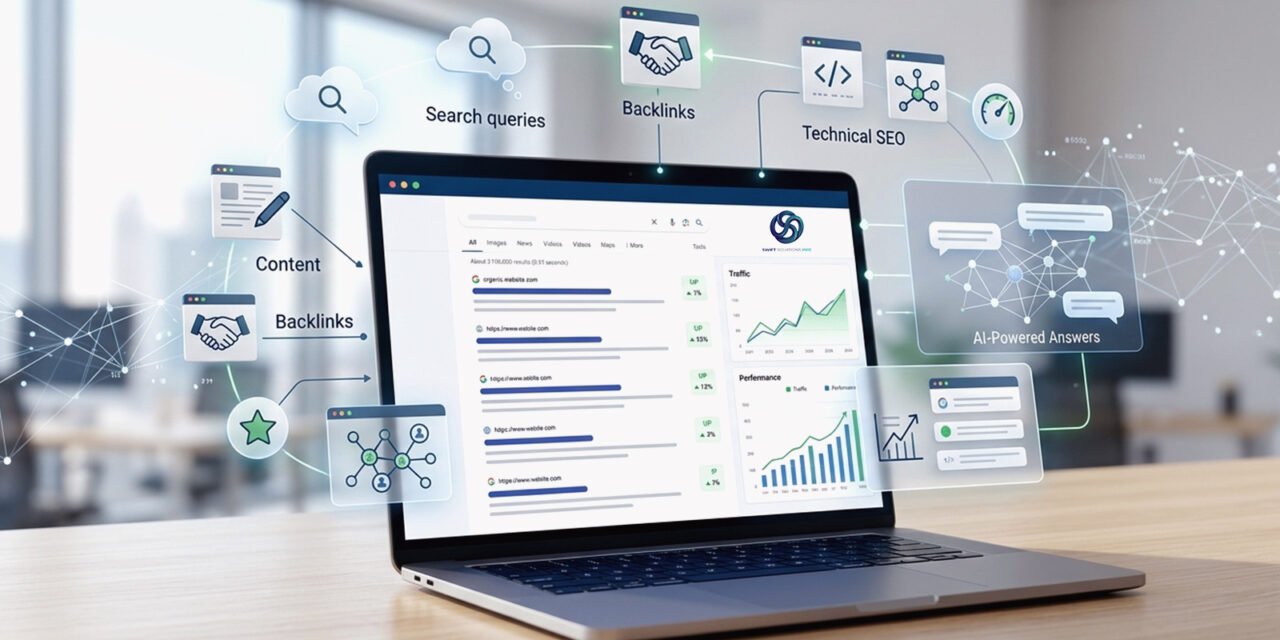
If you think about SEO as building a house, your content is the room, the technical SEO is the basement, the internal links are the hallway, and the external references are the road that leads someone to the house. All are fundamental, and if one is missing, the experience will be lacking.
Moreover, you do not need to be obsessed with overall SEO related topics, but to understand what Google values most and create a website that can easily satisfy and help users by answering their queries or concerns.
What Is SEO in 2026?
SEO, or Search Engine Optimization, is the process of improving the website structure, content, and authority of websites to help and understand search engine results easily in a better way and connect them with the right audience.
The goal of SEO is to increase visibility in search results, making it easier for people to find the right, helpful, trustworthy, and informative content. When they search for information, products, or services.
The fundamental concept remains the same. It is the search context that has gone through changes.
As per Google’s search essentials, the process can be divided into technical requirements, spam policies, and SEO guidelines. Google also suggests that content should be insightful, credible, and user-centric, as well as relevant and indexable. They also advise on the appropriate formatting of non-textual content, for example, images, videos, or audio clips.
So, in simple terms, SEO today is not about trying to use a keyword on the page twenty times.
It basically helps Google figure out:
- What is your page about?
- For whom was it created?
- Is the page useful for the targeted audience?
- Is it crawlable and indexable?
- Does the website provide a better user experience
- Does your content deserve its place in the search results for that query
Quite a valuable distinction.
Does SEO Still Work in 2026?
Yes, SEO still works in 2026, but it works differently than many expect.
SEO in 2026 will seem very different. It’s more important to provide clear, useful information than to fill it with keywords. Search engines like Google focus more on user intent, real experience, and content quality.
However, success isn’t guaranteed simply because you publish an article and add keywords.
Google’s own documentation says that meeting its technical requirements and adopting best practices make the content eligible to appear on search result pages, but it does not guarantee that Google will crawl, index, or serve a page.
That means SEO should be viewed as a long-term process rather than a button you press.
There is another major reason SEO remains relevant: Google itself continues to publish its latest SEO guidance. In 2026, Google added guidance specifically about optimizing websites for generative AI tools and emphasised that traditional SEO best practices remain relevant for AI-powered search experiences.
Therefore, the question is whether SEO disappears or not.
The better question is: Are you practising SEO in a way that matches modern search?
What Matters Most for Google Rankings in 2026?
There is no hidden magic in Google’s ranking factors.
According to Google, their automated ranking systems utilise numerous signals and functions at the page level and are aimed at finding the most relevant and helpful results.
The main areas to focus on for the majority of websites are:
Search intent and relevance: Are you solving the real reason someone searched?
Helpful, original content: Is this page actually new or just another copy?
On-page SEO: Are your meta titles, headings, copy, links, images and other elements clear and descriptive?
Technical SEO: Can Google crawl, render, and understand your pages without issues?
Internal Linking: Can users and bots find related pages easily?
Website experience: Is the site fast, safe, accessible, and easy to use?
Quality external references: Are you earning links naturally, or cutting corners?
These are not isolated tricks. They always work together.
Google Ranking Factors in 2026: What We Actually Know
SEO professionals often publish lists containing hundreds of supposed Google ranking factors in 2026.
Be careful with those lists.
Google does not publish a simple master spreadsheet saying “Factor A is worth 7 points, and Factor B is worth 3 points.” Its ranking system uses numerous signals and systems, and Google explains that ranking is performed using multiple systems rather than one single formula.
We do know, however, that Google continues to emphasise helpful and reliable content.
Its guidance asks creators whether their pages provide original educational information, substantial coverage, insightful analysis, value beyond what already exists, accurate information, and a satisfying user experience.
Google also explicitly warns against creating content primarily to attract search-engine visits, producing large quantities of content across unrelated subjects, extensively automating content without value, and rewriting other people’s material without meaningful additional insights.
That’s a useful lesson for anyone studying SEO ranking factors in 2026: don’t confuse an SEO theory with a confirmed Google requirement.
Why Search Intent Matters More Than Keyword Density
Imagine someone searches:
“Beginner’s best running shoes”
What do they want?
Not necessarily a 1,500-word version of the history of running shoes.
It seems they are interested in recommendations, comparisons, buying guides, or advice on choosing the best pairs.
That’s definitely the search intent.
A page may include your keyword dozens of times, but it will still fail to rank well if it does not fulfil the aim of the search.
Information from Google’s SEO guidelines includes tips about choosing applicable keywords for content creators and that Google’s language models interpret page content’s relevance to a search query without the need to include all possible variations of a keyword phrase.
So instead of asking, “How many times should I use my keywords?” ask:
“What exactly does this individual need?”
If the search is purely informational, offer a straightforward response.
Compare searches for significant dissimilarities.
If it is transactional searches, ensure that products, prices, specifications, and the buying process are “handled” since that is where the people are moving.
How to help people find you: Make it easy to understand and valuable for people to discover your location and business information.
This method lasts far longer than keyword stuffing.
Creating Helpful Content That People Actually Want to Read
Google’s people-first guidance is one of the clearest indicators of what matters for SEO in 2026.
Ask yourself.
- Does this page provide original information?
- Does it answer the reader’s question completely?
- Does it offer genuine experience or expertise?
- Is the information accurate?
- Would someone bookmark it or recommend it?
- Does it provide something beyond what the competing pages already say?
- Is it written for people rather than primarily for search engines?
Google specifically recommends evaluating the Who, What, When, Where, Why, and How behind content. That means making authorship clear when appropriate, explaining how content was produced when useful, and ensuring the fundamental reason for publishing is to help people.
This is especially important in an era of digital and generative AI.
Anyone can ask an AI system to produce a generic article.
Your advantage is therefore not simply producing more words. It’s providing experience, evidence, originality, examples, analysis, testing, opinions supported by facts, or information that is difficult to replicate.
That is exactly the kind of non-commodity content Google encourages in generative AI search as well.
On-Page SEO Best Practices for 2026
On-page SEO is still worth it, but it is best when it reads as normal.
Begin with an explicit, descriptive title of the page.
According to Google, title links can be created from the file’s < title> tag and other signals as well, and the rendered titles should be helpful to users in assessing a result and clicking on it.
If necessary, your main keyword can show up in the title, even if it doesn’t really make sense; just don’t sacrifice clarity to make that occur.
You should also pay attention to:
Headings: Three clear H1, H2, and H3 headings, which will be simple to scan through if necessary.
Introduction: A brief sentence about what is going to be discussed.
Images: Include images where appropriate and descriptive alt text for accessibility.
URLs: Maintain any important URLs simple and clear.
Internal links: Use descriptive anchor text to link between related pages.
Meta descriptions: Create enticing excerpts that give an accurate preview of the page.
Structured data: When the structured data makes sense for your page, implement it.
Google explicitly mentions that structured data can be used to give a better understanding of page contents to Google and could possibly bring search features a user may be eligible for.
The objective is straightforward: make the page comprehensible for people and for search engines too.
Technical SEO: The Foundation of Search Visibility
Great content can’t do much if Google can’t access it.
Google’s technical requirements are actually fairly straightforward. A page needs to be accessible to Googlebot, return a successful HTTP status, and contain indexable content.
That makes technical SEO less mysterious than it sometimes sounds.
Check this:
- Important pages aren’t accidentally blocked.
- Robots.txt isn’t preventing necessary crawling.
- Important pages can be indexed.
- Canonical URLs are handled correctly.
- Internal links work
- Your site uses HTTPS.
- Pages don’t depend on inaccessible content.
- Mobile users can access the same important information.
- Redirects work correctly
- Duplicate versions are handled appropriately.
Google’s documentation also explains that Canonicalization helps it determine the primary version when similar or duplicate URLs exist.
Technical SEO is essentially housekeeping.
You may not notice it when everything works, but problems become obvious when it doesn’t.
Website Speed, Mobile Experience and Core Web Vitals
No one likes waiting for some pages to load.
Within the Google search algorithm, Google Core Web Vitals seek to assess the real-time loading speed of the page, page responsiveness, and visual stability. The current formulae are:
- LCP: Indicates loading speed
- INP: Indicates response rate.
- CLS: Operationalises the presence/absence of continuity.
Google advocates an LCP of 2.5 seconds or lower, an INP of less than 200 milliseconds, and a CLS of less than 0.1 for a good experience.
However, don’t fall into the trap of assuming that Core Web Vitals are part of your SEO strategy.
According to Google’s guidance, webmasters should aim for an overall good page experience, not just a few narrowly focused ones.
So, I ask broad questions:
Easy for visitors to the page?
Is this site usable on phones?
Is your intrusive content intruding?
Are users able to get all the relevant information in a short period?
Do you feel the page is steady while it is loading?
That’s much better than dwelling on any one individual’s technical score.
Internal Linking and Site Structure
Internal linking is one of the easiest to do SEO techniques, but it is often the most neglected. An effective internal linking structure guides visitors to other related pages and helps search engines understand how various pages relate to each other.
For instance, if you run a website about digital marketing, a post about keyword research would make perfect sense to point to a relevant page about content strategy, technical SEO, local SEO, analytics, or SEO tips. This allows visitors and search engines to browse your website in a logical way.
Internal links will distribute the link equity around your website and make it easy for Google to locate and index your important web pages. Use crawlable links so that your website gets listed in more locations:
Relevance and User-Friendly Target keywords are most important when adding links and how anchor text should be presented. The anchor text should give the user a hint of what to expect once they reach the destination page.
Instead of:
Click here
Try:
Learn more about technical SEO
The second example provides useful context for both visitors and search engines.
Further down the page, you may want to add links to related pages (as appropriate). For instance, a blog entry written about SEO would be best linked back to your SEO or Digital Marketing services page, while, by the same token, other blog entries about SEO would be useful to include links to.
But don’t get carried away with internal linking; don’t place links just for the fun of it. Each link should be useful and contain relevant keywords.
Quick internal linking checklist: Showing internal links to related blog posts.
- Use descriptive and relevant anchor text.
- Link the key service or category pages that you will want to market to related content.
- Ensure other key pages are reachable by link.
- Use descriptive anchors and avoid all general anchors like click here.
- Reject internal linking to your pages. If you add an unreasonable number of internal links to any given page or overall, Google will penalize you in the listings.
- Cross-reference older articles and insert links to any new similar articles where appropriate.
Having a solid internal linking structure not only makes it easier for search engines to crawl your website, but it also makes for a better content experience for your visitors and enables them to access more of your website.
Backlinks, Authority and Brand Mentions in 2026
Backlinks haven’t magically disappeared.
Google’s ranking systems documentation says link analysis systems, including PageRank, remain part of its core ranking systems.
But that doesn’t mean every backlink is valuable.
Buying links specifically to manipulate rankings, excessive link exchanges, automated link-building, and other manipulative practices are covered by Google’s spam policies.
A healthy strategy is to create things people genuinely want to reference.
For example,
- Original research
- Useful statistics
- Detailed tutorials
- Expert commentary
- Free tools:
- Original studies
- Interesting case studies
- Comprehensive resources
When other relevant websites naturally reference your work, the link has a legitimate reason to exist.
Brand visibility can also matter indirectly because people who recognise your business may search for it, visit it directly, mention it, or share its content.
The important distinction is earning attention rather than manufacturing signals.
How AI Is Changing SEO in 2026
AI is probably the biggest change affecting SEO in 2026.
Google now provides generative AI experiences in Search, including AI Overview and AI Mode, and its documentation specifically addresses how websites can appear in these experiences.
Does that mean traditional SEO is dead?
No.
Google’s own guidance says foundational SEO best practices continue to provide the basis for visibility in generative AI searches.
AI changes how people discover information, but websites still need to be crawlable, understandable, useful, and valuable.
AI also changes how content is produced.
Using AI as a writing assistant, research helper, brainstorming partner, or editing tool is different from mass-producing low-value pages simply to capture search traffic.
Google’s people-first guidance specifically warns against using automation, including AI generation, primarily to manipulate search rankings.
So, the winning approach isn’t “AI versus SEO.”
It’s AI-assisted work combined with genuine human values.
AI Overviews, AI Mode and SEO for AI Search
If you want to understand AI and SEO in 2026, start by ignoring most supposed “AI and SEO hacks.”
Google’s current AI optimisation guidance says valuable, unique, people-first content is more important than creating commodity content. It also advises site owners to continue applying foundational SEO practices.
That means you should focus on:
Clear answers: Make important information easy to understand.
Original insights: Say something useful that isn’t simply copied from dozens of other websites.
First-hand experience: Where appropriate, demonstrate experience of the subject.
Strong structure: Organise information logically.
Reliable information: Support important claims with trustworthy evidence.
Accessible content: Make sure Google can crawl and understand your pages.
Interestingly, Google also says site owners don’t need to chase tactics such as unnecessary AI-specific files or supposed “AEO/GEO hacks” simply for Google Search.
In 2026, optimising for AI search is therefore less about gaming an AI system and more about creating information worth retrieving.
Common SEO Mistakes, Practical Strategy, Metrics and Checklist
SEO Mistakes to Avoid
This is what you’ll generally want to avoid:
- Keyword stuffing
- Creating lots of thin content
- Copying competitors
- Purchasing shady backlinks
- Creating keyword pages without any knowledge of user needs
- Neglecting technical aspects
- Blogging about irrelevant topics simply because they get searched.
- Relying on AI-generated content instead of actual expertise
- Obsessed with word count
- Chasing new acronyms from SEO experts
According to Google, there isn’t a “perfect” word count for creators.
A page consisting of 700 words can be brilliant.
A page with 3,000 words is pointless.
The real question is whether the page succeeds in its purpose.
How to Improve Google Rankings in 2026: A Proven Method
To rank better on Google in 2026, follow this practical strategy.
Step 1. Define your target audience. Who do you serve?
Step 2. Identify search intent. What does the searcher want?
Step 3. Create the best possible answer that helps satisfy search intent. Provide original insights, examples, evidence, and experience.
Step 4. Optimise the page. Adjust the titles, headings, URLs, images, and other elements of the structure.
Step 5. Sort out any technical issues. Ensure crawling, indexing, rendering, and navigation are easy.
Step 6. Boost the user experience. Test mobile usability, speed, readability, accessibility, and stability.
Step 7. Promote genuinely useful resources. Earn attention and legitimate references instead of purchasing manipulative backlinks.
Step 8. Measure and optimise. Use Search Console and other tools to discover problematic pages.
This way, you don’t have to chase every single update from Google.
SEO Metrics to Track in 2026
Do not rely on rankings alone when evaluating your SEO performance.
Key metrics include:
- Organic clicks
- Organic impressions
- CTR
- Indexed pages
- Search queries
- Conversion rate from organic traffic
- User engagement and business outcomes
- Important landing pages
- Core Web Vitals
- Backlinks and referring domains
- Organic traffic-related revenue or leads
Google Search Console is particularly helpful for assessing your site’s performance in Google Search. Google also provides reports related to its generative AI-powered search features.
The most valuable metric depends on your objectives.
For a publisher, it may be qualified traffic.
For an online retailer, it could be revenue.
For a service business, it could be leads.
Traffic that doesn’t bring any business results isn’t success.
SEO in 2026: A Checklist
Before you publish the page, make sure that:
Content
– It satisfies the search intent.
Sure, here is a more relaxed version, preserving all the key points and details:
Is it original and useful?
– Is the information provided accurate?
– Is it written by someone with the right expertise?
On-page SEO
– Is the title descriptive?
– Is there a clear primary heading?
– Are the subheadings useful?
– Are the internal links relevant?
– Are the images optimised and clear?
Technical SEO
– Can Google crawl pages?
– Can the page be indexed?
– Does it render correctly?
– Are the critical URLs canonicalised?
Experience
– Does it work well on mobile?
– Is it fast enough?
– Is the layout stable?
– Can users easily navigate the page?
Trust
– Is authorship clearly stated when it is needed?
– Are the critical claims supported by evidence?
– Are the backlinks earned, not manipulative?
By answering these questions, you address many of the fundamentals recommended by Google itself.
Final Thoughts: Where SEO Is Heading Next
SEO in 2026 is not going to be as much about discovering a puzzle of ranking factors.
What will change is that searching will always be more conversational, visual, and AI-enabled. But Google’s fundamental purpose will remain the same: to help people find what they’re looking for.
They will not be irrelevant.
- Generate content for humans
- Understand search intent
- Make sure your website is easy to use and accessible to everyone.
- Construct an adequate internal design.
- Design an engaging experience
- Draw real interest
- Be creative with the innovative use of AI
That’s what the guidance for 2026 from Google is informing us about – basic search engine optimisation makes an impact when it comes to generative AI search, and having high-quality, distinct content is all the more critical.
So, if you are attempting to learn how to make your site rank well in Google in 2026, don’t begin by trying to find out what trick the algorithm is craving right now.
Rather, start by asking yourself one question.
“Would my visitors feel comfortable being on my page?”
If yes, then you are on the right track for building a liquid base that will stay current when search technology changes.
Frequently Asked Questions
Does SEO still work in 2026?
Yes. SEO remains useful for making websites findable and readable in Google Search. But new advances in Google have shown that simply complying with Google’s technical and SEO best practices does not necessarily guarantee higher rankings, as there are many ranking systems and signals in use.
What SEO elements are most relevant for Google in 2026?
There is no single officially confirmed list of factors with fixed weights. Significant categories are relevance, value and dependable content, technical usability, links and page experience. Google uses many systems and signals to judge pages.
Does AI-generated content hurt SEO in 2026?
It’s not about the fact of using AI. Google searches for helpful, trustworthy, unique, human-created content. If it’s automated, solely for the purpose of gaming the algorithm, that’s against our spam policies.
What can you do to improve your website’s visibility in Google search in 2026?
First, hone in on matching search intent, craft truly helpful content, optimise on-page, address technical SEO problems, enhance internal linking, provide better overall page experience, and obtain authentic backlinks from other sites.
What are the biggest SEO trends in 2026?
Key innovations, summarised here, include: AI Overviews; AI Modes; generative AI search experiences; continued focus on people-first content; and increased focus on unique information and firsthand information. Google has continued to maintain that fundamental SEO is still applicable in the new search experiences.